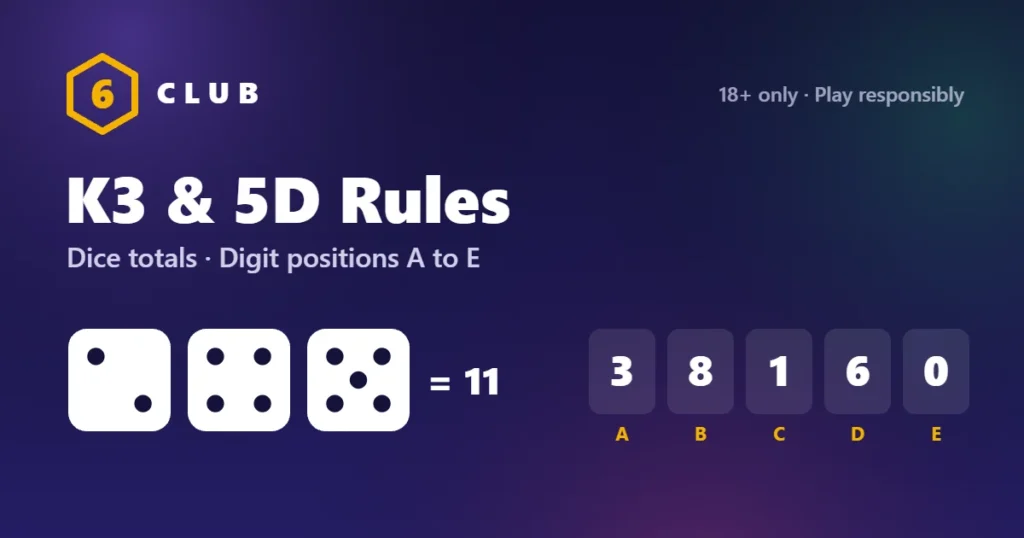
K3 and 5D are the two number games on 6 Club that go beyond a single result. K3 rolls three dice, and 5D draws five digits at once. Here’s how both work: what’s drawn each round, every choice you can make, how Big/Small and Odd/Even are decided, and worked examples. Both games are in the Lottery section after your 6 Club login.
K3 rules
Each K3 round rolls three dice, each showing 1 to 6. The three values are added together for a total from 3 to 18.
What you can choose in K3
| Choice | Matches when |
|---|---|
| Total | The sum of the three dice equals your number (3–18) |
| Big | The total is 11–18 |
| Small | The total is 3–10 |
| Odd / Even | The total is odd or even |
| Two of a kind | Exactly two dice show the same value |
| Three of a kind | All three dice show the same value |
| Three different | All three dice show different values |
K3 worked examples
| Dice | Total | Size | Odd/Even | Pattern |
|---|---|---|---|---|
| 2 · 4 · 5 | 11 | Big | Odd | Three different |
| 1 · 1 · 3 | 5 | Small | Odd | Two of a kind |
| 6 · 6 · 6 | 18 | Big | Even | Three of a kind |
| 3 · 2 · 5 | 10 | Small | Even | Three different |
How often each total appears
Not all totals are equally likely, because more dice combinations add up to the middle values. There are 216 possible rolls of three dice:
| Total | Combinations (of 216) |
|---|---|
| 3 or 18 | 1 each |
| 4 or 17 | 3 each |
| 5 or 16 | 6 each |
| 6 or 15 | 10 each |
| 7 or 14 | 15 each |
| 8 or 13 | 21 each |
| 9 or 12 | 25 each |
| 10 or 11 | 27 each |
This is basic dice maths. It describes how often each total comes up over many rounds, not what the next roll will be. Every roll is random and independent.
5D rules
Each 5D round draws five digits, each from 0 to 9, in positions A, B, C, D and E. You can make choices about any single position or about the sum of all five.
What you can choose in 5D
| Choice | Matches when |
|---|---|
| Digit at a position | That position shows your digit (e.g. A = 7) |
| Big / Small at a position | Big is 5–9, Small is 0–4 |
| Odd / Even at a position | The digit at that position is odd or even |
| Sum Big / Small | The total of all five digits is in the upper or lower half of 0–45 |
| Sum Odd / Even | The total of all five digits is odd or even |
5D worked example
The draw is 3 · 8 · 1 · 6 · 0:
| Position | Digit | Big / Small | Odd / Even |
|---|---|---|---|
| A | 3 | Small | Odd |
| B | 8 | Big | Even |
| C | 1 | Small | Odd |
| D | 6 | Big | Even |
| E | 0 | Small | Even |
| Sum | 18 | Small | Even |
Round timers
K3 and 5D each run in several rooms with different timers. The countdown for each room is shown at the top of the game. Every room is a separate game with its own period numbers and results history.
K3 vs 5D: which suits you?
| K3 | 5D | |
|---|---|---|
| What’s drawn | 3 dice (1–6) | 5 digits (0–9) |
| Main choice | The total | A digit at a position |
| Options per round | Moderate | Many |
| Best for | Dice fans who like simple totals | Players who like more options per round |
New to 6 Club? Start with Wingo, which has the simplest rules (see the Wingo rules and colour chart), then try K3.
FAQ
What is the highest and lowest K3 total?
The lowest is 3 (1 + 1 + 1) and the highest is 18 (6 + 6 + 6).
Which K3 totals come up most often?
10 and 11, because 27 of the 216 possible rolls add up to each of them. Every roll is still random.
What do the letters A to E mean in 5D?
They’re the five positions in the draw, from first (A) to last (E).
Are K3 and 5D results random?
Yes. Every result is generated at random and is independent of previous rounds.
See all games in 6 Club lottery games explained.